
No Greenville County Warrant Lookup
No official public online active-warrant search was located for Greenville County. That finding matters because a search result from an old page, social post, or third-party list should not be treated as a live warrant check. The official channels found in the research are the Sheriff's Warrant Services phone line, warrant-tip and dispatch channels, court records, Public Records, FOIA, and the Solicitor docket for active General Sessions cases.
The Greenville County Sheriff's Office Warrant Services Division receives active warrants and maintains original warrants for service. The office also handles extradition and transport work, warrant teams, Fugitive Apprehension and Special Investigations Team work, and warrant investigations. Captain Brad McAlister is listed for Warrant Services at 864.467.5242 and bmcalister@greenvillecounty.org. The Warrants Office phone is 864.467.5241, with phones answered during business hours or messages accepted.
Important: Do not rely on stale online warrant information for surrender, travel, bond, or employment decisions.
Greenville County Warrant Channels
Greenville County warrant access works as a fallback chain. Warrant Services is the direct Sheriff's Office channel for warrant-service questions. Time-sensitive wanted-person information after normal business hours goes to dispatch at 864.271.5210 option 8, or 911 in emergencies. That dispatch path is for reporting wanted-subject information, not for casual warrant checks. The warrant-tip email page requires JavaScript, so it should be treated as a tip path rather than a searchable database.
| Channel | Use It For | Contact or Source |
|---|---|---|
| Warrant Services | Active warrant-service questions and original warrant routing. | 864.467.5241 |
| Captain Brad McAlister | Warrant Services command contact listed by GCSO. | 864.467.5242; bmcalister@greenvillecounty.org |
| Dispatch after hours | Time-sensitive wanted-person information. | 864.271.5210 option 8; 911 for emergencies |
| Public Records / FOIA | Law-enforcement records, public-record requests, or warrant-related public information. | 4 McGee Street, Suite 119; 864.467.5278 |
| Issuing court | Bench warrants, failure-to-appear warrants, or court-specific process. | Circuit, Family, Probate, Magistrate, Drug Court, or Municipal Court |
The East Greenville Summary Court page shows one local Magistrate Court channel that can matter for warrant and bond questions.
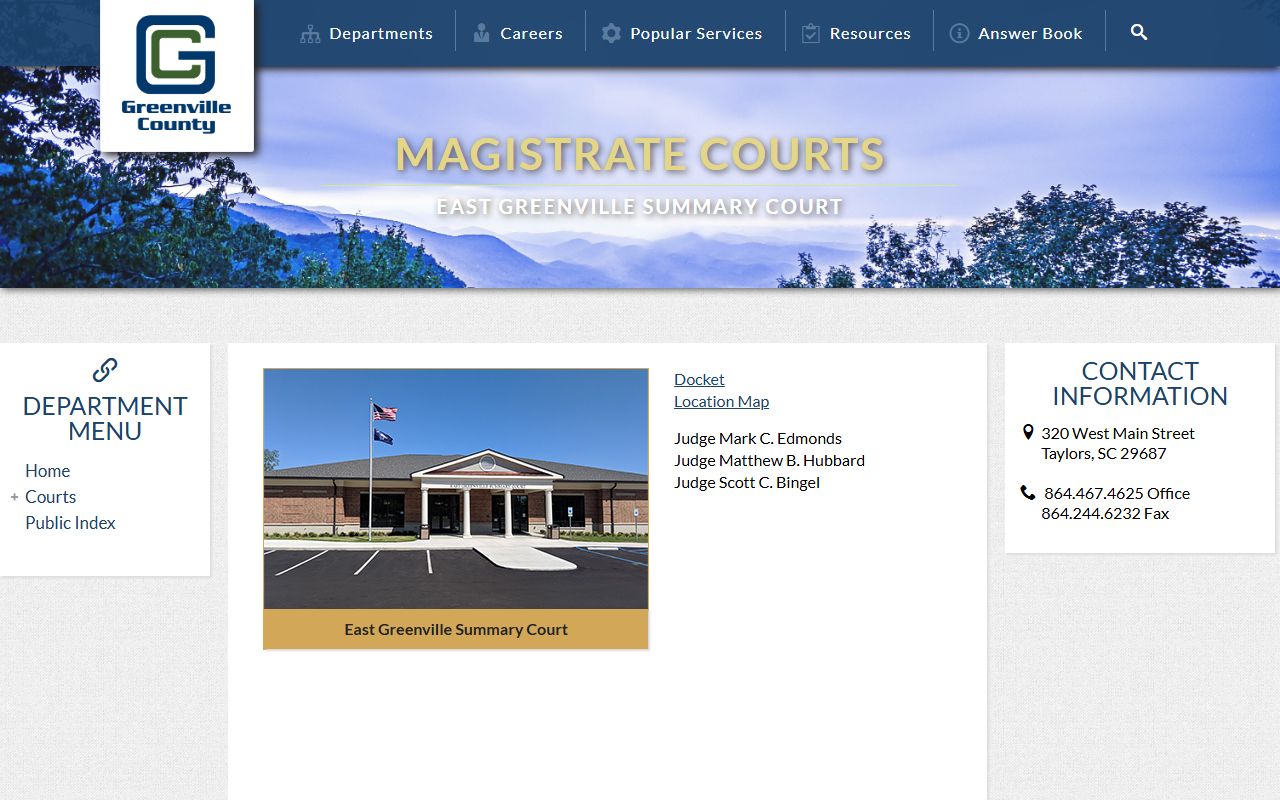
Magistrate Court is important because magistrates can issue arrest warrants and handle early bond or preliminary matters.
Greenville County Warrant Types
Greenville County warrants may come from different courts and different facts. Sheriff's General Order 229 states that arrest warrants are issued by magistrates based on sworn testimony by affidavit of law enforcement stating that a South Carolina law violation occurred. The same policy says any deputy may serve a warrant anywhere in Greenville County. After arrest, the person is taken before a magistrate as soon as possible for arraignment and bond information, then processed through booking, fingerprints, and photograph.
- Arrest warrant means a magistrate-authorized criminal process based on sworn law-enforcement facts.
- Bench warrant means a court order often tied to failure to appear or failure to comply with a court requirement.
- Municipal failure-to-appear warrant can arise from a missed city court case, such as a City of Greenville or Mauldin Municipal Court matter.
- General Sessions warrant number may appear as a case identifier in the Public Index or Solicitor docket.
- Search warrant is different from an arrest warrant because it authorizes a search, not a public wanted-person listing.
Note: Bench warrants can be issued by General Sessions, Common Pleas, Family Court, Magistrate Court, Drug Court, and Probate Court.
Greenville County Warrant Fields
Because no official public active-warrant search was found, there is no public search-field table to render for a live warrant portal. The most concrete official field inventory comes from Sheriff's General Order 229. It identifies defendant information needed for warrant records and policy details about entry, service, and court return. This inventory is useful when asking a court, Warrant Services, Public Records, or an attorney to help identify the correct warrant.
| Field or Detail | What It Shows |
|---|---|
| Full first, middle, and last name | The identity information needed to match the defendant to the warrant. |
| Current address and phone | Contact and location information listed as required defendant data. |
| Hair color and eye color | Physical identifiers included in the warrant-information inventory. |
| Warrant number | A key identifier that may appear on Solicitor dockets or Public Index General Sessions searches. |
| Indictment number | A General Sessions identifier used with the warrant number for criminal-document requests. |
| Issuing court | The court that can recall, hear, or resolve a bench or arrest warrant. |
| NCIC entry timing | GCSO policy says criminal warrants are entered into NCIC within 72 hours if possible. |
Greenville County Court Warrant Checks
Court-issued bench warrants require court-level checks. General Sessions, Common Pleas, Family Court, Magistrate Court, Drug Court, and Probate Court can all issue bench warrants depending on the case. A missed traffic or ordinance date may be with Municipal Court. A lower-level criminal warrant may be with Magistrate Court. A felony or serious misdemeanor case may be reflected in General Sessions file information, the Solicitor docket, and later Clerk records.
The Solicitor docket is especially useful for active General Sessions cases because the research identified fields such as warrant number, indictment number, defendant, and date of arrest. The Clerk does not schedule General Sessions court dates; the Thirteenth Circuit Solicitor schedules those dates and notifies defendants, victims, and attorneys by mail.
The Gantt Summary Court page shows another local Summary Court that may be part of a Greenville County warrant check.
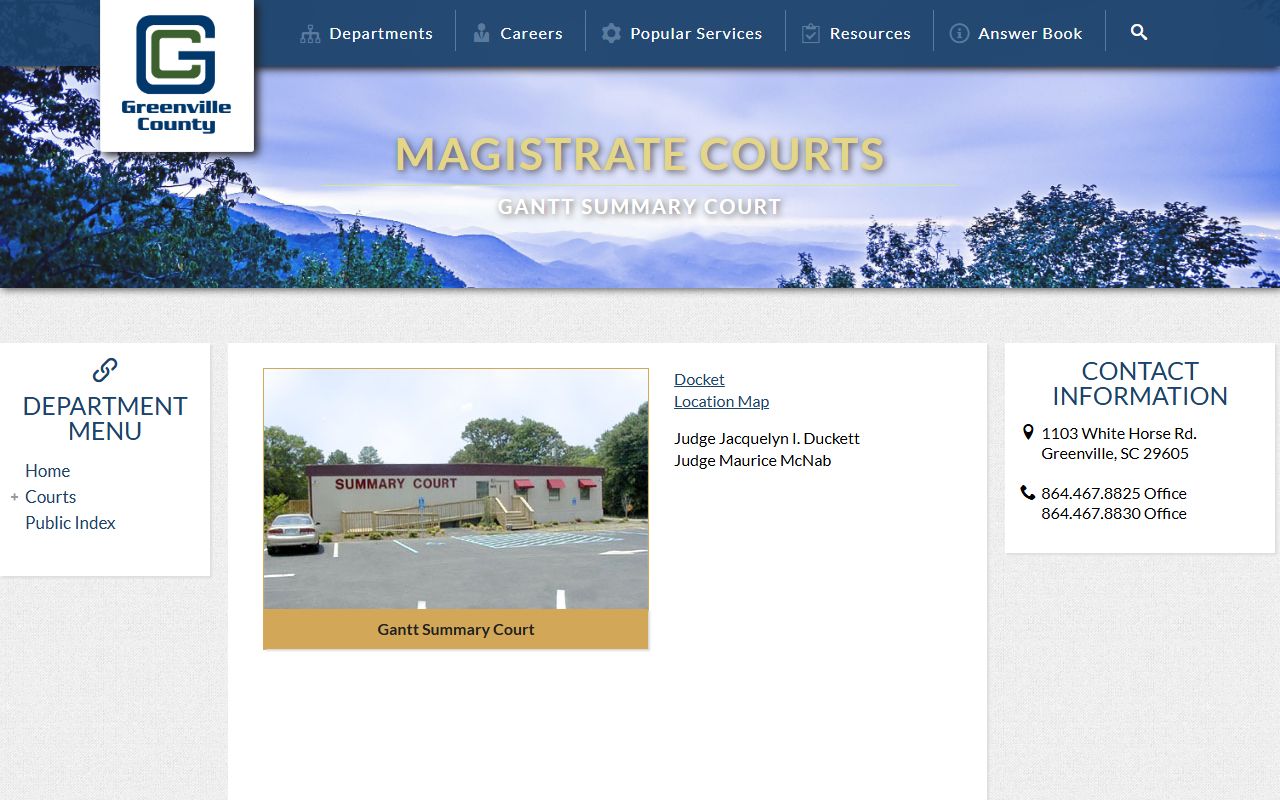
Summary Court routing is local, so the right office can depend on where the charge, address, or missed hearing belongs.
Greenville County Warrant Record Requests
Public Records and FOIA are fallback routes when an official search channel does not provide the needed record. Greenville County Public Records is at 4 McGee Street, Suite 119, Greenville, SC 29601, phone 864.467.5278, email publicrecords@greenvillecounty.org. The Sheriff's Public Information or FOIA contact identified in the research is Courtney Fitzpatrick at CFitzpatrick@greenvillecounty.org. County FOIA requests can also be sent through the County Attorney process when a department-specific request is not the right route.
Relevant Public Records fees include a 5-year local background check at $5, a 10-year local background check at $10, a background check beyond 10 years at $15, additional arrest data such as warrant number or case number at $3 per every five charges, an electronic booking jail record at $3, a paper inmate booking report at $6, mug shots at $3 black and white or $6 color, and certified summary court disposition at $1.
FOIA is useful as a records process, but it is not an emergency warrant-clearance tool. Greenville County FOIA requests must reasonably describe the record and may be routed to the department or to the County Attorney's Office at County Square. For records less than 24 months old, the researched FOIA timing gives a 10-business-day availability response window. Older records can take longer, and court-controlled or confidential warrant records may still be withheld.
Resolve Greenville County Warrants
Resolving a Greenville County warrant starts with identifying the issuing court or agency. For a bench warrant, contact the court that issued it. For a criminal warrant, contact Warrant Services, the issuing Magistrate Court, or counsel. If the case is in General Sessions, the Solicitor docket and Clerk Criminal Records identifiers can help tie the arrest warrant number to the indictment number. If the person is arrested, expect Magistrate or Bond Court steps unless the warrant directs a no-bond or court-only hold.
- Confirm whether the issue is a Magistrate, Municipal, General Sessions, Family Court, Probate, or other court warrant.
- Save the warrant number, ticket number, indictment number, case number, and court date from any paperwork.
- Call Warrant Services or the issuing court before appearing at a random office.
- For defense advice, contact private counsel or the Greenville County Public Defender if eligible.
- Keep proof of payment, disposition, recall order, or bond action because clearance can lag across systems.
Restricted Greenville County Warrants
Some warrant-related records are not ordinary public copies. The Clerk identifies dismissed warrants as an exception to public file access, along with sealed judicial-order cases, juvenile cases, adoption filings, and filings prohibited by law. Juvenile records are confidential under South Carolina law. Sealed records require court authority. A search warrant may not be publicly available while an investigation is active or when a court restricts access.
Warrant records can also be split by system. NCIC entry is not a public county search. Municipal failure-to-appear warrants may be controlled by the city court. A General Sessions warrant number may appear in a docket, but document copies require the Clerk's Criminal Records Department when the record is a General Sessions court document. The safest reading is narrow: verify the exact warrant with the office that issued or services it.
Greenville County's warrant research also shows why a single name search can miss the real source. A bench warrant from Probate Court, Family Court, Drug Court, or Municipal Court may not look like a new criminal arrest warrant. A criminal warrant may start with a magistrate affidavit, move to booking and bond, and later connect to a Solicitor docket. The court that issued the warrant is the office that can explain recall, bond, hearing, or compliance requirements.
City court warrants are a separate practical concern. The City of Greenville Municipal Court portal states that online information is not the official record and that official records are on file in city offices. That matters for failure-to-appear warrant questions because a city ticket or ordinance case may need Municipal Court confirmation, while county Magistrate Court, Circuit Court, or the Sheriff's Office may only see part of the history.